BoltPipeline logo

Your pipelines break in production.
We catch issues before they run.

Validated against your live database — before execution.

Continuously monitored after they run — with exact issue diagnosis.

Build pipelines at AI speed.
Without breaking production.

Checked against your live database before execution
Flags issues before they impact production
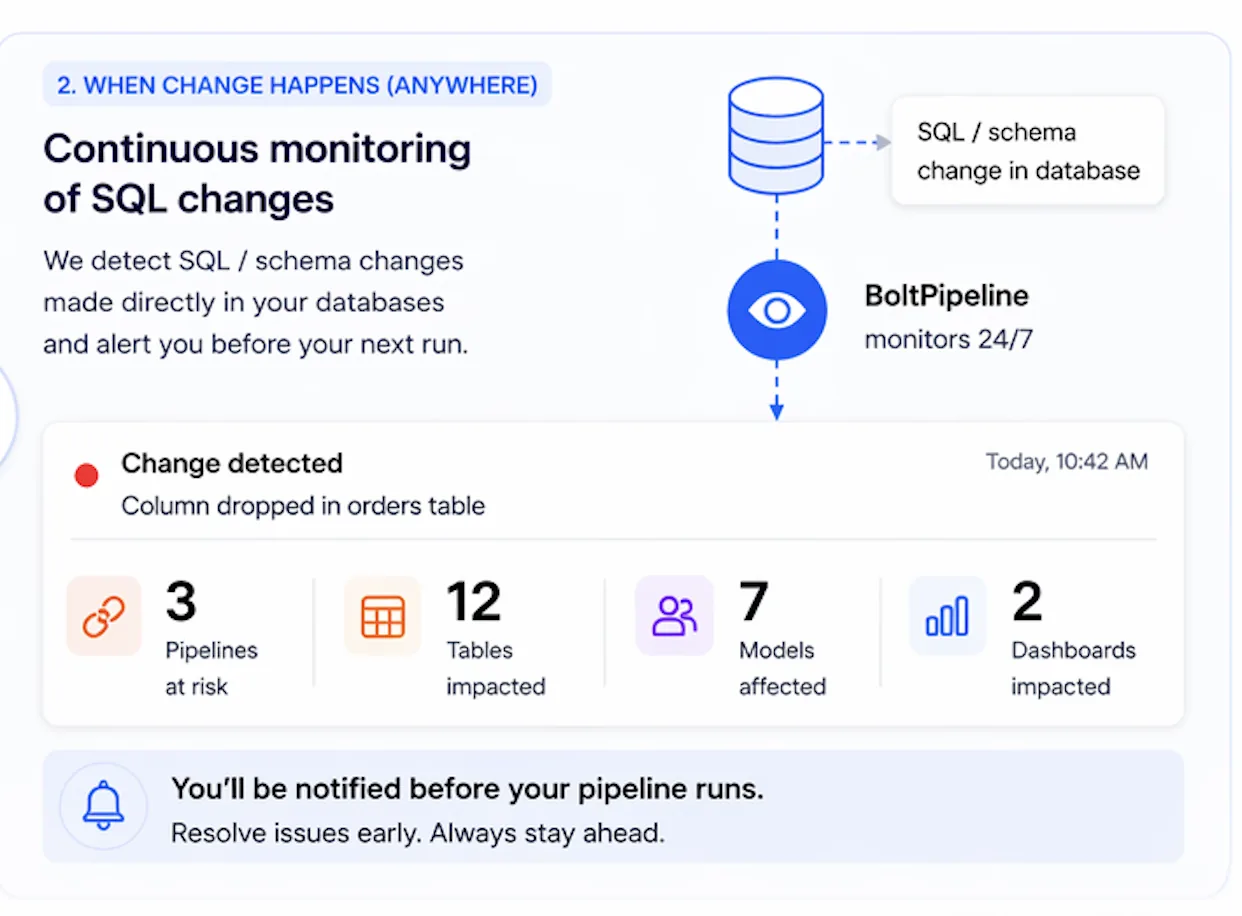
Continuously monitors pipelines in production
Pinpoints exact issue, root cause, and downstream impact

Understand BoltPipeline in 2 minutes

Pipelines don’t fail because you lack tools. They fail because nothing verifies them against reality before they run.

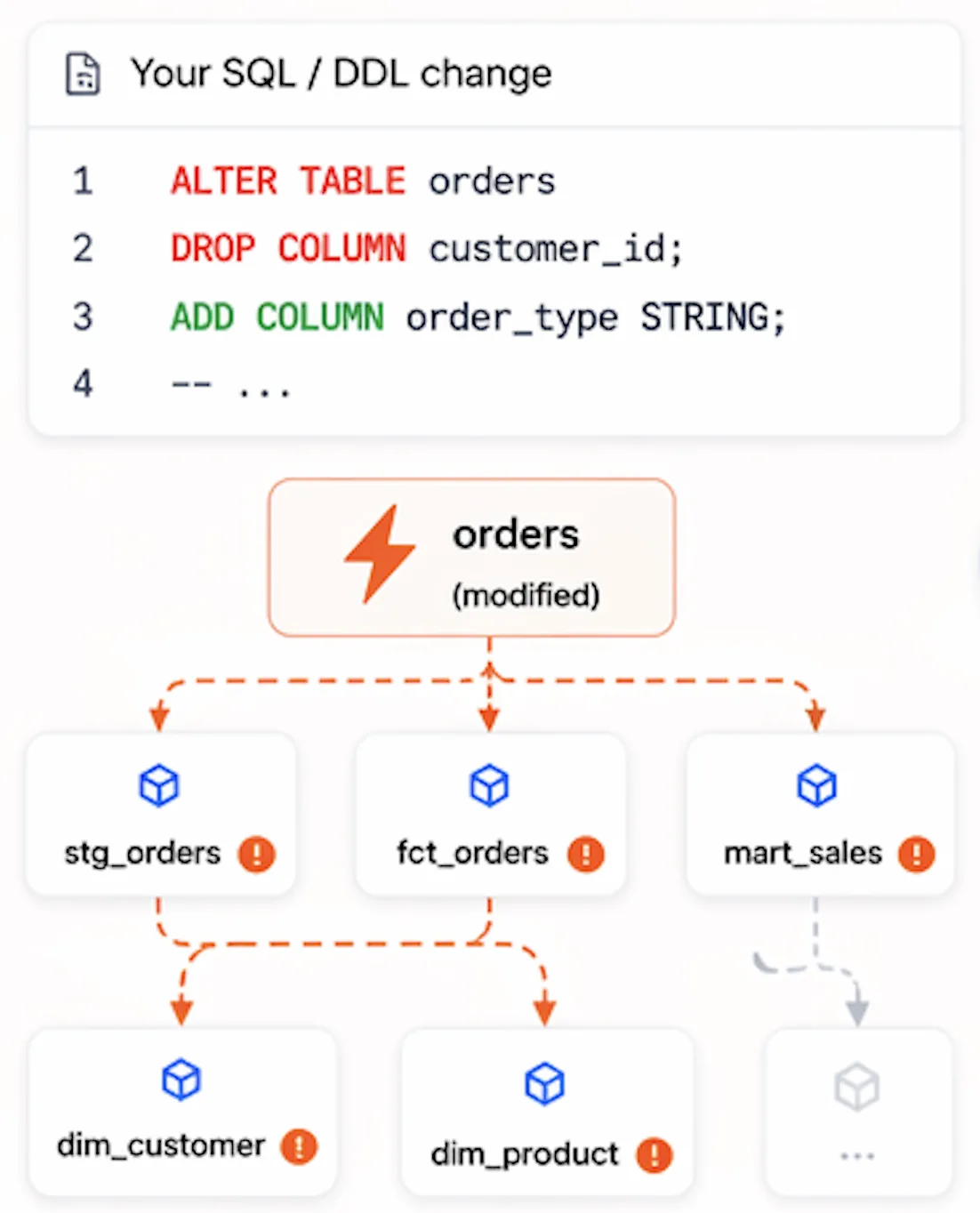
Schema changes upstreamColumns disappearJoins break silently

You run them anyway. And find out in production. Dashboards go stale. Debugging begins.

Observability is too late.
Testing is too shallow.

No tool answers the questions that actually matter:

1

Will this pipeline work on my current production data?

2

If something changed upstream, will I know before it breaks?

16
Validation Rules per Pipeline
0
Uncertified Deploys
1
Platform, Not 3-4 Tools
100%
In-Database Execution

BoltPipeline validates pipelines before they run — and continuously monitors them after.

Checked against your live database before execution

Flags issues before they impact production

Continuously monitors pipelines in production

Pinpoints exact issue, root cause, and downstream impact

Before execution. During execution. End-to-end.

How It Works

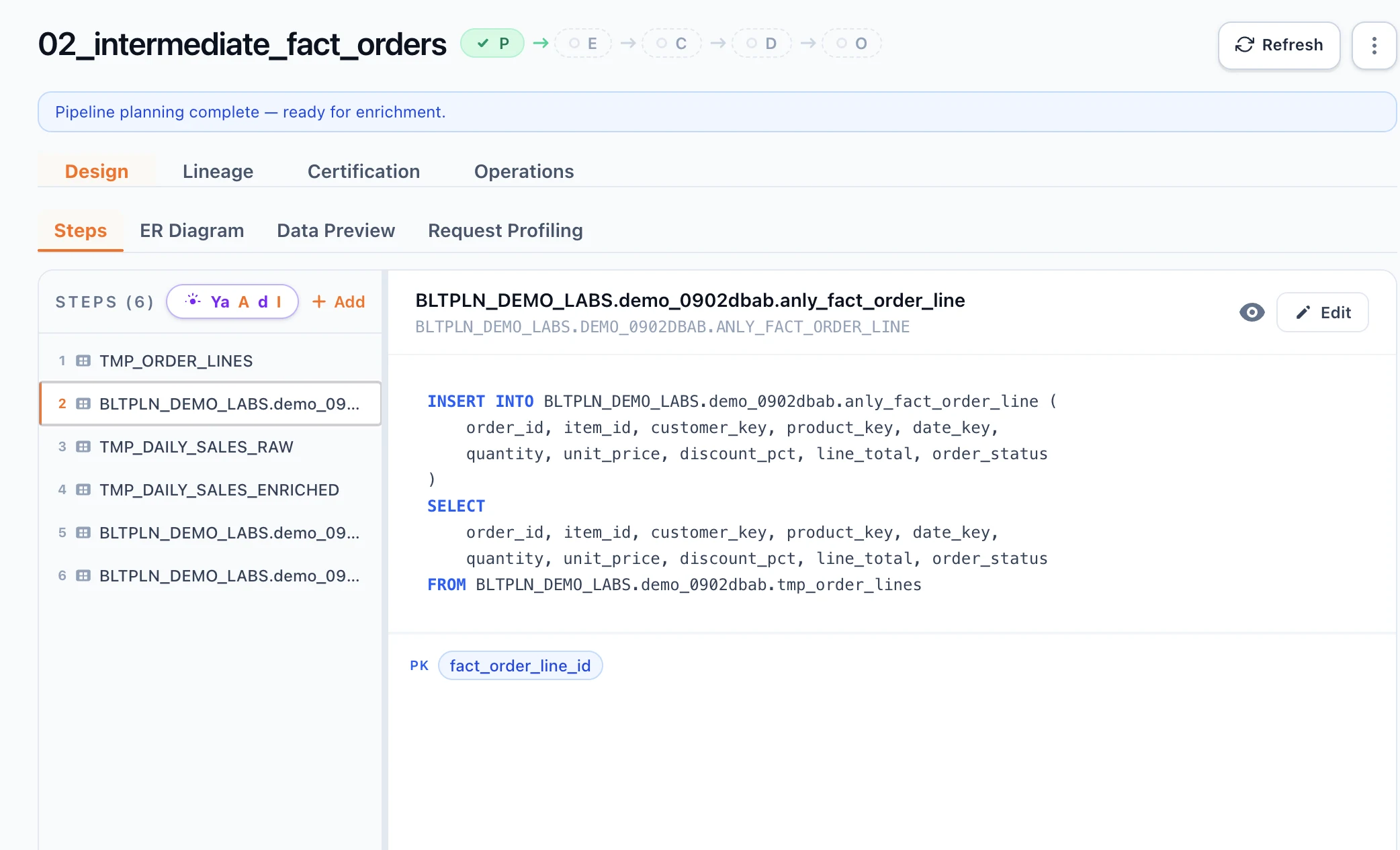
Plan a deployment-ready pipeline from SQL
1

Plan

Submit SQL → generate a deployment-ready pipeline

Certify against the live database before execution
2

Certify

Validate against live database → block failures before they run

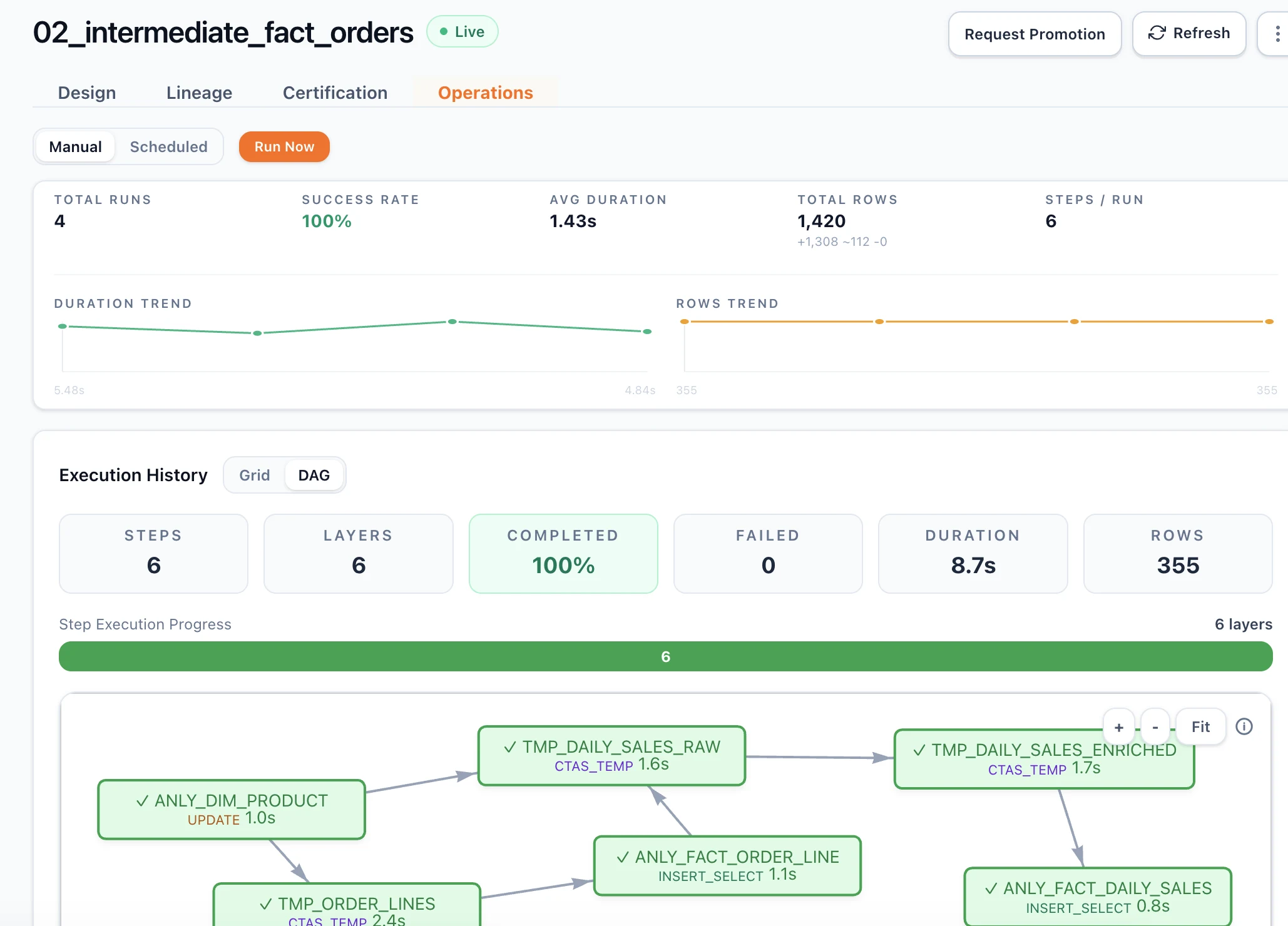
Operate with continuous monitoring and instant diagnosis
3

Operate

Run with continuous monitoring → detect and diagnose instantly

Nothing runs without certification.

Nothing runs without visibility.

Architecture

YOUR ENVIRONMENTManaged by Your TeamYour DatabaseSnowflake · PostgreSQL · SQL ServerData stays here — always2Executes SQL3Collects metadataBoltPipeline AgentRuns in your environmentPulls work · Executes locallyYour team manages · BP has no accessSendsmetadata →← PullsconfigsSECURITY BOUNDARYmTLSBOLTPIPELINE CLOUDManaged · Secure · Always OnCommand CenterOrchestration & governance engineCompiles · Validates · Certifies · Governs1Pipeline config4Results · LineageConsoleYour team logs in hereConfigure · Monitor · Approve · GovernExecutes SQLMetadataConfigData never leaves your environment

Everything required to validate and monitor pipelines — built in.

Not separate tools. One system. No gaps.

Transformation

SQL in. Certified pipelines out.

  • Compiles SQL into execution-ready pipelines
  • Automates SCD Type 0, 1 & 2 merge logic
  • Generates ANSI SQL artifacts you own

Data Quality (Certification)

Nothing ships uncertified.

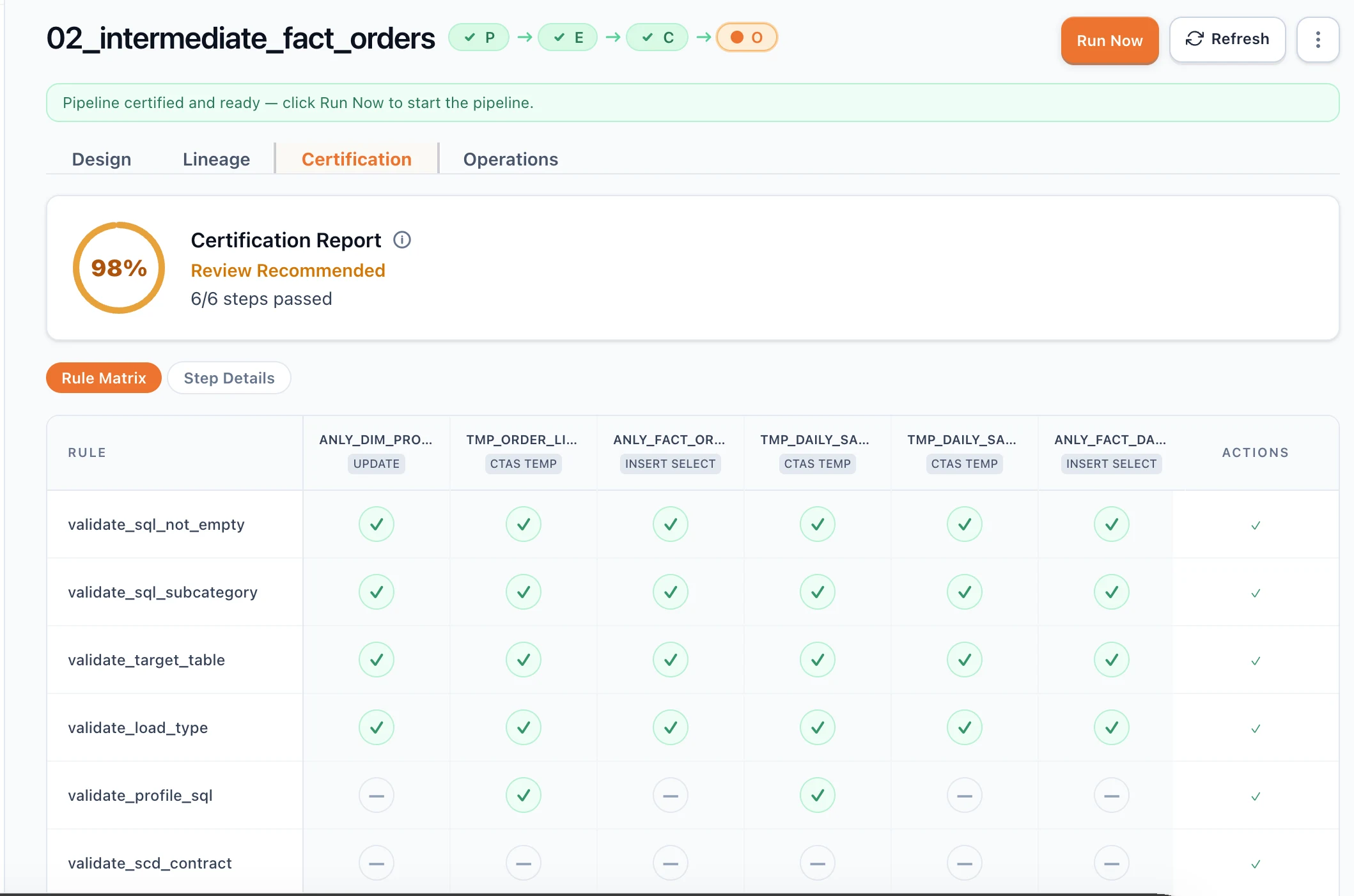
  • 16-rule engine validates against your live DB
  • Checks schema, joins, types, SCD integrity
  • Hard gate — blocks deploy until green

Orchestration (Operate)

Schedule. Deploy. Execute.

  • Dev → Int → Prod lane promotion
  • DAG-parallel execution inside your DB
  • Automated scheduling & deployment

Catalog & Metadata (Discovery)

Know everything. Expose nothing.

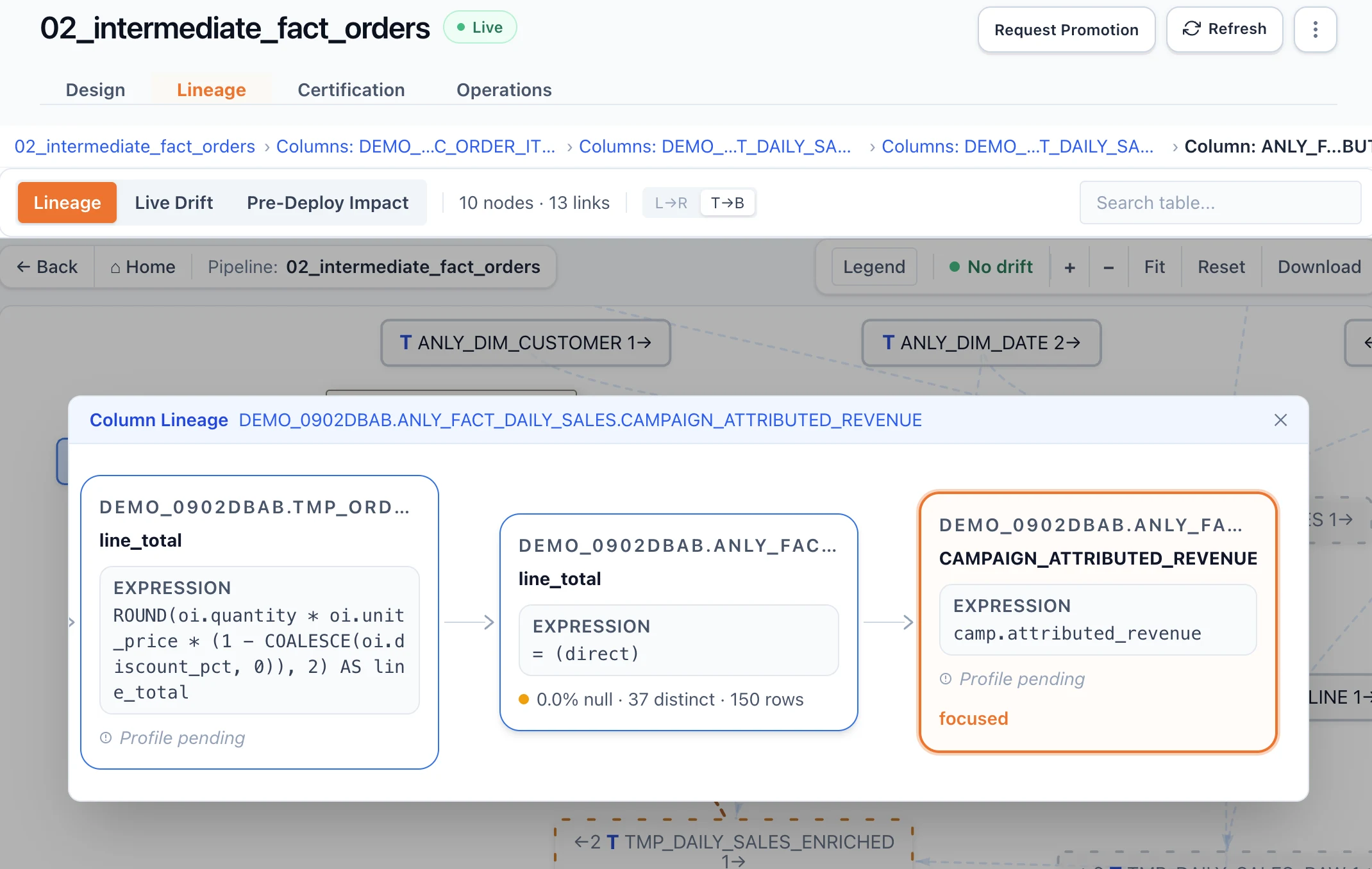
  • Auto-generated column-level lineage
  • In-DB profiling — we see aggregates, never rows
  • PII detection & classification

Observability

See it before it breaks.

  • Continuous schema drift detection
  • Volume & freshness anomaly monitoring
  • Pipeline health scoring with root-cause tracing

Security

We see the flow. Never the data.

  • Per-agent mTLS with X.509 certificates
  • Credentials never leave your network
  • All execution inside your database

Governance

Earn your way to production.

  • Tollgate approvals & role-based access
  • Certification gates at every promotion
  • Full audit trail on every change

One schema change can break 20 downstream pipelines.

We catch it before it runs.

Stop broken pipelines before production

Eliminate hours of debugging — know exactly what and where

Prevent silent data corruption downstream

Ship pipelines with confidence

Your data never leaves your environment.

Agent runs inside your network. Metadata only.

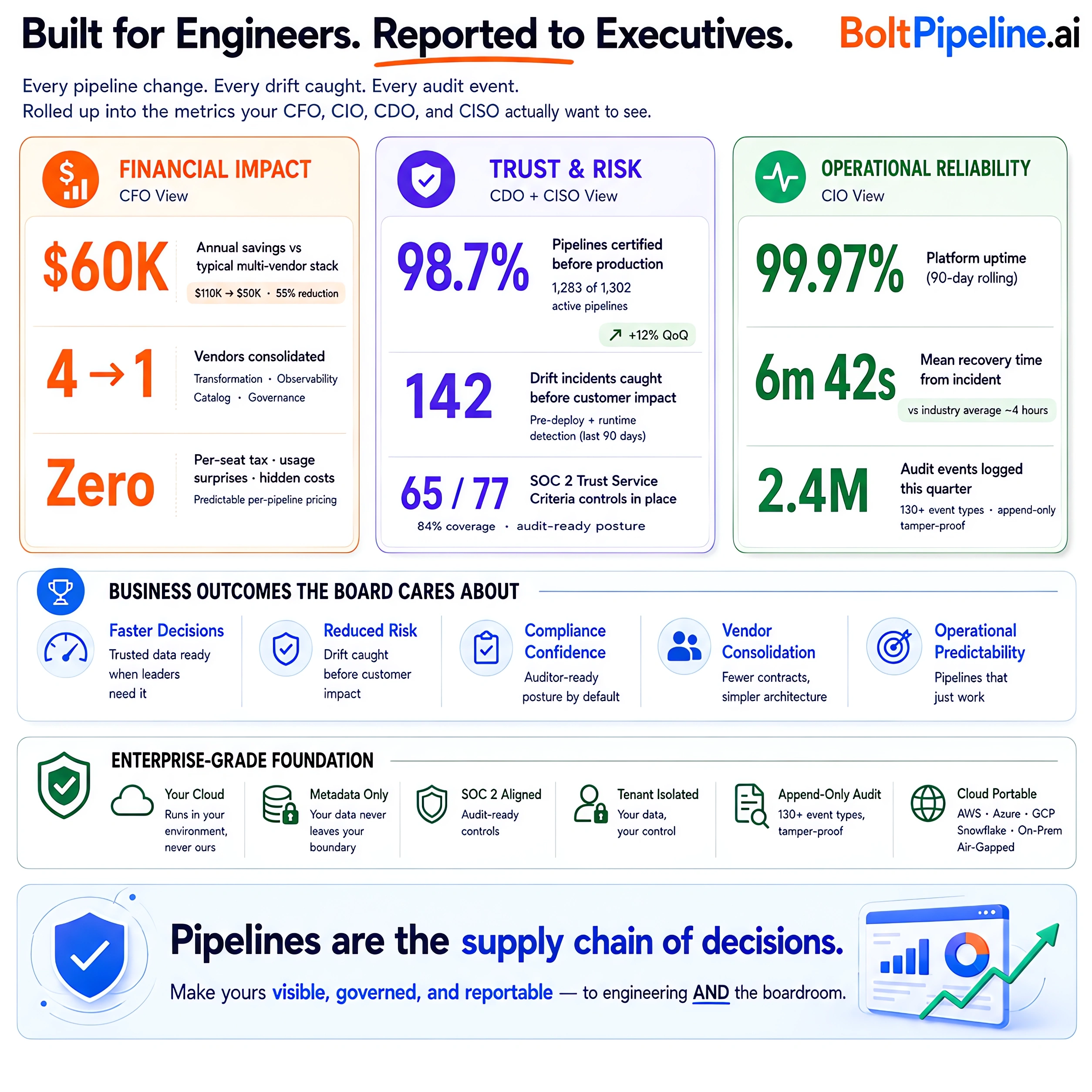
Zero data exposure. Compliance by architecture.

HIPAA · GDPR · PCI · SOC 2 · Data Residency

Enterprise Model

Metadata Without Enforcement Is Just Documentation

Any catalog tool can label a table as SCD Type 2. Only BoltPipeline will stop a pipeline from violating that classification — at certification, before it reaches production. In the AI era, where pipelines are generated in seconds, the platform has to be the governor.

The AI era problem

Your team can generate 10 pipelines before lunch. Can your governance keep up?

In the pre-AI era, one developer deliberately built one pipeline. Conventions and code review were enough — the surface area was small. Today, AI generates SQL in seconds. Multiple teams use AI agents simultaneously. Pipelines multiply. And without platform-level enforcement, they silently compete: two pipelines claiming to produce the same table, each with a different SCD strategy, neither aware of the other. The old answer — tribal knowledge, conventions, manual review — does not scale with AI speed. Governance has to move into the platform.

ConventionCertification rule

"We agreed SCD Type 2 tables don't get overwritten" → "This pipeline fails certification because it violates the table's SCD contract."

Tribal knowledgePlatform metadata

"Ask Sarah which pipeline owns dim_customer" → "The Enterprise Model shows the certified producer, last version, and all consumers — instantly."

Post-incident discoveryVisible before you build

"We found out two pipelines were writing to the same table after the production failure" → "The Enterprise Model shows the existing certified producer before you write a line of SQL."

Three things the platform does — not your team

Governance that lives in the platform, not in people's heads or team conventions.

01

Every table has a known certified producer

Visible, tracked, unambiguous

BoltPipeline records which certified pipeline writes to each table. Before anyone — developer or AI agent — builds a new pipeline targeting that table, they can see who already owns it. Conflicts surface as design decisions, not production incidents.

02

SCD type is validated at certification

Fails certification if violated

When a table is classified as SCD Type 2, any pipeline writing to it is checked at certification for conformance. A pipeline producing overwrite (Type 1) semantics against a Type 2 table does not pass. The catalog classification is the contract — validated before production.

03

Certified SQL is immutable

No runtime modifications

Once certified, the SQL is locked. No hotfixes, no silent edits in production. Any change requires a new version and a new certification cycle. What passed in Development is exactly what runs in Production — always.

Every table knows its lineage

The producer/consumer graph is derived automatically from pipeline certifications — not from manual annotation. It cannot go stale because it is generated from the same certifications that enforce the rules above.

One producer

Tracked

Each managed table has one certified pipeline recorded as its producer. Any team building a new pipeline can see this before they start — eliminating silent competition between pipelines.

All consumers tracked

Automatic

Every pipeline that reads from a table is recorded as a consumer at certification time. When the table changes, you see the complete downstream blast radius instantly.

Impact analysis

Before you certify

Change a table's SCD type, rename a column, or swap the producer pipeline — BoltPipeline shows every affected downstream consumer before any change is certified.

Coverage map

Inventory

See what is actively governed, what is orphaned (no active producer), and what raw data exists that no certified pipeline is transforming — your unmined analytics opportunity.

This is what we mean by enterprise governance. Not a label on a table. Not a convention your team is supposed to follow. Not a separate catalog tool you buy, integrate, and maintain. Governance baked into the platform — enforced at every certification, tracked in every table, visible on one screen.

How the Enterprise Model works →
Myth Buster

Connecting AI to Your Database Isn't Enough

AI can connect to your database — that's easy. But all it sees is table names and column types. Without structured metadata — column roles, SCD strategies, PII classifications, data quality scores, relationship cardinality — AI guesses. Confidently. Incorrectly.

What AI gets from a raw database

  • Table names: dim_customer
  • Column names: id, email, status
  • Data types: varchar, integer, date
  • No context. No quality. No relationships.

Result: hallucinated SQL that looks right but isn't.

What AI gets from BoltPipeline

  • Column roles: primary key, foreign key, business key
  • SCD strategy: Type 0, 1, or 2 with tracking columns
  • PII classifications, data quality scores, health scores
  • Relationship cardinality, lineage, drift baselines

Result: correct SQL, first time. 80+ fields of context.

1

AI Suggests

Using 80+ real metadata fields, AI drafts transformations grounded in your actual data model — SCD logic, joins, masking, lineage.

2

You Validate

Review through ER diagrams, column-level lineage, drift reports, and health scores. You decide what moves forward.

3

PCO Certifies

Plan → Certify → Operate. Profiling validates, model versions lock, audit trails record. Nothing ships uncertified.

We bring clarity to your data model. We never see your data. Our agent sends structure and statistics — table names, column types, null rates, uniqueness scores. Never row values. Never PII content. Never data previews. The same rich metadata that gives you clarity powers AI to build better analytics at scale. Other agents run in your VPC but still move data. Ours doesn't.

New Capability

Cross-Database Intelligence

The same customers, orders, and products exist across multiple databases — different names, different types. Finding those overlaps used to take months. BoltPipeline detects duplicates, scores similarity, and generates migration plans with column-level mappings — in days, not months.

🔍Detect duplicates across databases
💪Cut redundant storage and compute
🚀Migrate with automated DDL and type mappings
Reconcile data integrity before and after

How It's Different

🔍Similarity detection — compares structures, names, and types across databases
🧠AI semantic matching — resolves “cust_id” vs. “customer_identifier” automatically
📊Profile-driven scoring — cardinality and distributions confirm matches beyond names
💰Cost optimization — find duplicate storage and compute you didn't know about

⚡ How It Works

1Profile2Score3Resolve4Migrate

🌟 Months of analysis → Days. Manual spreadsheets → Automated. Guesswork → Data-driven migration plans.

Roadmap

Data Loading — governed data ingestion into your warehouse with the same certification and audit trails you already trust. Today we handle transformation; loading is next.

Roadmap

Multi-Database Support — Snowflake today. PostgreSQL, MySQL, Oracle, and others on the roadmap. Same platform, any warehouse.

Stop broken pipelines before they reach production.

See how BoltPipeline validates pipelines against your live database — before they run and while they run.

Turn SQL into Production-Ready Data Pipelines — Faster and Safer

SQL-first pipelines, validated and governed — executed directly inside your database.

No new DSLs. No fragile orchestration. Just SQL with built-in validation, lineage, and governance.